

Satake Satoru Gyuto (Chef's knife) Japanese kitchen knife Footballer - Japanese quality in the kitchen
145 $
123 $
15
Satake Satoru Gyuto (Chef's knife) Japanese kitchen knife Footballer - Japanese quality in the kitchen
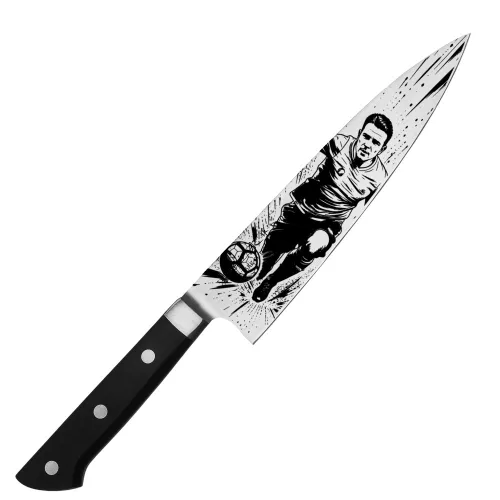

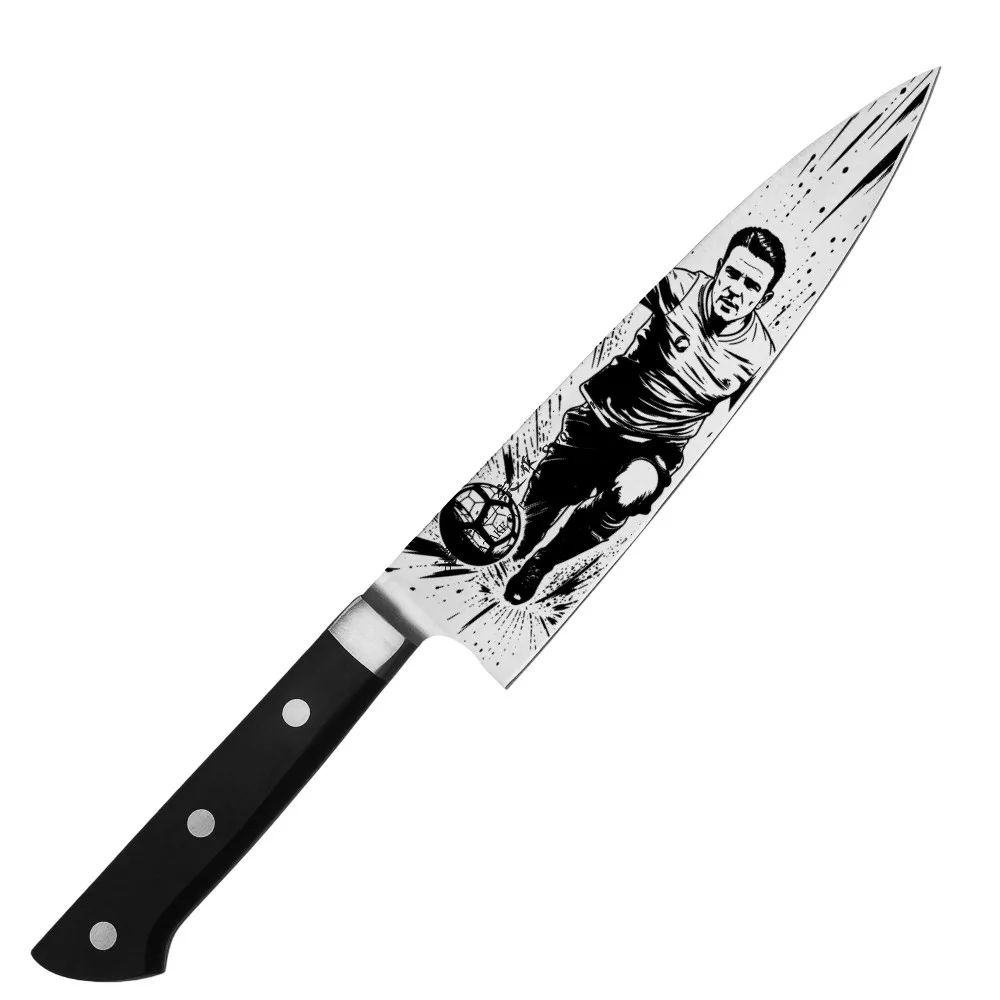
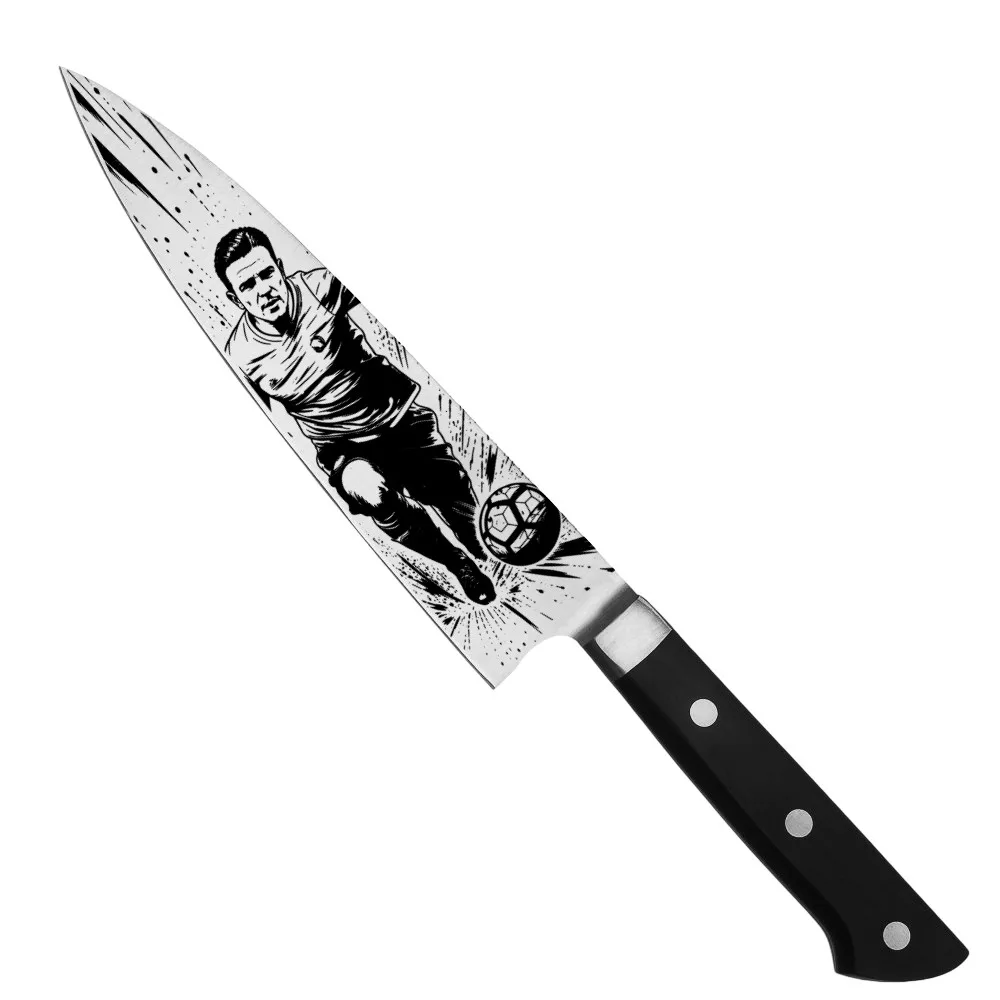
We pay tribute to the legendary era of Hungarian football with this blade, so that with every cut you can feel the fire that connects generations on the sidelines. Just as a striker's movement holds raw power and their gaze holds pinpoint accuracy, this knife becomes the master of your kitchen, evoking the legendarium of our greatest idols. This special Satake chef's knife is not just a tool, but a symbol of your unquenchable love for the sport, bringing the magic born on the pitch into your home.
The blade is engraved on both sides!
Blade material - AUS-8A stainless steel
Handle material - Hard plastic laminate
Hardness - 58-59 HRC
Total length - 34.1 cm
Blade length - 21 cm
Blade width - 4.6 cm
Blade thickness - 2.6 mm
Edge grind - double-sided symmetrical
Weight - approx. 173 g
Manufacturer: Satake Cutlery Mfg. Co., Ltd. Made in Japan.
Item number: 802-789-gravirozott-foci01

145 $
123 $
Start date: 23.06.2026
While supplies last
Discount
15
Savings
22 $
Points earned after purchase:
6 $
We also recommend the following product as an accessory
Details
SATAKE SATORU GYUTO 21 CM JAPANESE CHEF'S KNIFE FOOTBALL ENGRAVING
- THE VERSATILE KITCHEN KNIFE

ADDITIONAL INFORMATION:
How to use Japanese chef's knives correctly? (Click on the text to read the article.)
Modern Japanese knifemaking: Meeting of tradition and innovation (Click on the text to read the article.)
Look no further if you are seeking an unforgettable gift that combines everyday practicality with the exclusivity of artistic craftsmanship. Real value lies in quality: the premium Satake Japanese knife brings centuries-old, noble traditions of knifemaking into your home. These masterpieces guarantee unparalleled sharpness and perfect balance, making every use a true culinary experience.
We honor the legendary era of Hungarian football with this blade, so that with every cut you can feel the fire that connects generations on the sidelines. Just as a striker's movement holds raw power and their gaze pinpoint aim, this knife becomes the master of your kitchen, evoking the legendarium of our greatest idols. This special Satake chef's knife is not just a tool, but a symbol of your unquenchable love for the sport, bringing the magic born on the turf into your home.
The exceptional detail of the graphics coming to life on the blade is guaranteed by 100-watt MOPA laser technology. This modern process allows for high-contrast engraving that far surpasses traditional solutions. Each piece is crafted with sophisticated precision to radiate true luxury and durability.
Give a gift of lasting value, where the power of Japanese steel meets the passion for Hungarian football!
The Satake Satoru Gyuto is an extremely versatile Japanese kitchen knife, which is an indispensable tool for every hobby and professional chef. This 21 cm chef's knife is ideal for precise cutting of vegetables, fruits, meats, and fish. Thanks to its pointed design, it handles various filleting tasks such as deboning chicken breast, separating pork and beef from the bone, and filleting smaller fish (though work is even easier with a dedicated filleting knife). The optimal blade length allows for easier control and cutting of larger surfaces. A high-quality gyuto, or chef's knife, is the "soul of the kitchen."
The origin of the gyuto (牛刀) knife dates back to the Meiji era (1868-1912), when Japan opened its doors to Western culture. At this time, beef consumption became widespread in the country, and a knife suitable for processing this type of meat became necessary. The gyuto was designed based on the Western-style chef's knife, but with the thinner blade and sharper point characteristic of Japanese knives.
The word gyuto means "beef knife", and it was originally developed for this purpose. However, it soon became clear that the gyuto is an extremely versatile tool, excellent for other kitchen tasks as well. Today, the gyuto is one of the most popular Japanese kitchen knives worldwide. The Satake Satoru Gyuto is a perfect blend of traditional Japanese craftsmanship and the needs of the modern kitchen.
Key Features:
- Satake Satoru Gyuto Japanese chef's knife with football graphics on both sides
- 21 cm blade length
- Versatile use: for cutting vegetables, fruit, meat, fish
- Suitable for filleting and deboning
- Optimal blade length for easy control
- The "soul of the kitchen" - indispensable for every chef
KNIFE STEEL COMPARISON TABLE
|
Steel Type |
Type |
Composition (Main elements) |
Advantages | Disadvantages | Typical Use | Manufacturer |
| AUS-8A | Mid-range stainless steel |
Carbon: 0.70 - 0.75% Chromium: 13.00-14.50% Molybdenum: 0.10-0.30% Vanadium: 0.10-0.26% |
Good corrosion resistance: High chromium content. Easy to sharpen: Average hardness. Adequate edge retention: Perfect for everyday use. Cost-effective: Common choice in mass production. |
General edge retention: Requires normal frequency of sharpening. Lower wear resistance: Compared to harder Japanese steels. |
Kitchen knives. Everyday use pocket knives. Fixed blade knives. |
AICHI - JAPAN |
| FAX-38 |
High Speed Steel (HSS) Special use steel Japanese carbon steel |
Carbon: 1.23-1.33% Tungsten: 5.70-6.70% Molybdenum: 4.70-5.30% Vanadium: 2.70-3.20% Cobalt: 8.00-8.80% |
Excellent wear resistance: Due to high hardness and alloying elements. Extraordinary edge retention: For demanding cutting tasks. High heat resistance: Retains hardness even at high temperatures.
|
Harder to sharpen: Due to extraordinary hardness. Higher price: Due to high alloy content and manufacturing technologies. Not stainless: Japanese carbon steel. Recommended for expert hands! |
Professional chef's knives. Specialty knives where edge retention is key. Industrial cutting tools (e.g., drills, milling cutters). |
NACHI FUJIKOSHI - JAPAN |
| MVS10Cob (DAMASCUS) | Cobalt-alloy stainless steel |
Carbon: 1.00% Chromium: 14.27% Cobalt: 1.34% Molybdenum: 0.96% Vanadium: 0.21% |
Excellent edge retention: Due to cobalt content. Excellent corrosion resistance: Through the alloys. Balanced performance: For professional knives. Excellent toughness: Often compared to VG10 due to similar composition. |
Currently only available in Damascus version. More expensive than simpler stainless steels. |
High-end kitchen knives. Quality pocket knives. General purpose knives where durable edge is needed. |
NACHI FUJIKOSHI - JAPAN |
| U420J2 | Low carbon stainless steel |
Carbon: 0.15-0.36% Chromium: 12.00-14.00% Manganese: 1.00% Nickel: 1.00% Silicon: 1.00% Sulfur: 0.03% |
Excellent corrosion resistance: High chromium content. Easy to sharpen: Relatively soft (compared to other Japanese steels). Very flexible: Hard to break. Cost-effective: Basic Japanese stainless steel. |
Frequent sharpening: Compared to harder Japanese steels. |
Basic (home) kitchen knives. Diving knives (high corrosion resistance). Food industry equipment. |
NIPPON KOSHUHA - JAPAN |
| Japanese carbon steel (Traditional) |
Carbon: 1.25-1.35% Manganese: 0.20-0.30% Phosphorus: 0.02% Silicon: 0.010-0.20% |
Extraordinary sharpness: Very fine grain structure and high carbon content. Easy to sharpen: Often sharper than many stainless steels. Excellent cutting performance: Base material for traditional Japanese knives. Patina formation: Develops a characteristic surface over time. |
Prone to rusting: No chromium content. Maintenance intensive: Requires careful cleaning and storage. Recommended for expert hands! |
High-quality Japanese kitchen knives. Straight razors. Applications where sharpness is paramount and maintenance is not an issue. |
HITACHI - JAPAN |
Data
Blade length
Blade Width
Blade Thickness
Blade material
Hardness
Handle material
Overall length
Grind
Weight
Item number
802-789-gravirozott-foci01
Weight
173 g/db
Bundle offers
Reviews
Be the first to write a review!
Similar products